Stretching pennies, swaying minds: Maximising small budgets using behavioural thinking
In today’s fiercely competitive world full of abundant choice, noise and distraction, brands need to rise above the melee with strategies that motivate their target consumer. Having a memorable brand matters. But with ever-tightening budgets, this can sometimes seem an impossible task – especially if you’re trying to take on more established players that often have mightier spending power.
Yet, budget constraints needn't equate to limited impact. By speaking to your customers’ greatest motivations, and embracing key principles from behavioural science, even the smallest budgets can punch above their weight.
What’s critical is brand memorability – if your brand is fixed in people’s memories, it’ll be top of shopping lists, front of mind in web searches and first preference in stores. You’ll be the obvious, if not the only, choice. There are three aspects to making a memorable brand: motivation, top-of-mindness and ease. Get these right and your budget, however small, will work its hardest.
Motivation: what will help you gain competitive advantage?
‘Motivation’ has long been a core pillar of behavioural science – it is the driving force behind reaching one’s goal or preferred outcome. And ask any brand strategist, and they would agree that in the world of branding, differentiation comes from positioning brands and products so that they align with the core motivations of the target audience.
However, recently ‘distinctiveness’ has usurped differentiation. In the buzzword bingo of marketing teams across the globe, there’s an obsession with brands being distinct. But does distinctiveness deliver for a brand? Do we risk forgetting the established, and proven, models of marketing in favour of simply being unique?
Brands can spend millions on making themselves distinctive, but this isn’t enough because it misses the motivation component. You need to position your brand to appeal to your audience’s ‘motivation’ to want or need your product in the first place.
Customer motivations were critical in the reinvigoration of outdoor paving brand, Bradstone. Working with the brand to make it memorable, we needed to create a strong emotional connection between customers and their outdoor spaces. Outside living has undergone a cultural shift, from being ‘extra space’ to being a key element to people’s lifestyle, meaning that people are more motivated than ever to transform their outdoor spaces to reflect their personalities and tastes. The resulting ‘Create your Great Outdoors’ campaign tapped into this ‘self-expression’ motivation elevating everyday outdoor scenarios, showcasing the joyful result of transforming an outdoor space with Bradstone.
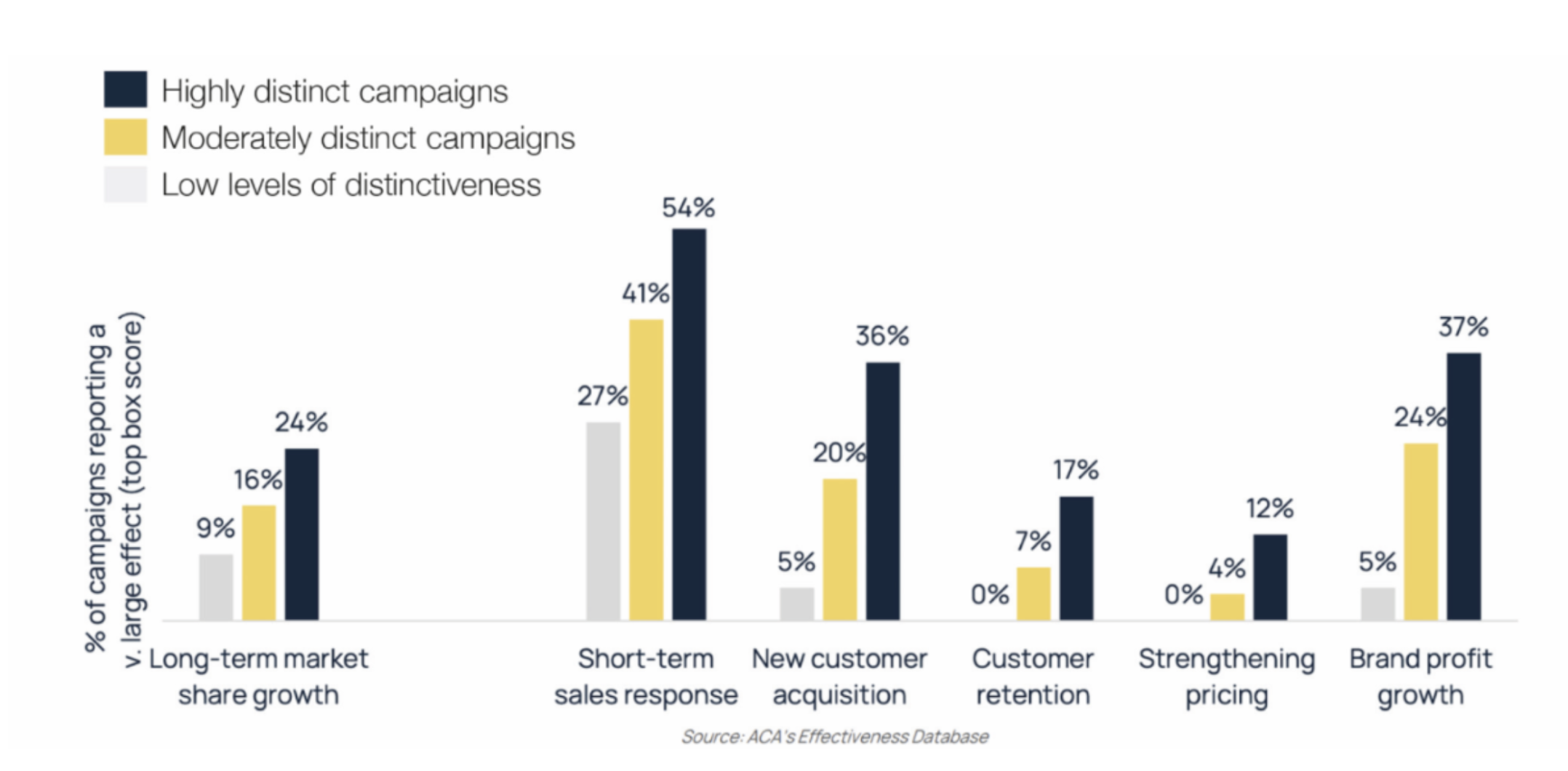
Memorable and distinct campaigns are shown to deliver greater long-term market share growth, short-term sales response, new customer acquisition, customer retention, strengthening pricing, and brand profit growth.
Top-of-Mind: are you the first brand your audience thinks of?
Top-of-mind awareness is about the cues and triggers you build in consumers’ memories. When buyers think of your category, does your brand come to mind first? If the competition is beating you at this point of recall, people are going to be reaching for other brands instinctively and not yours. It might not be an easy task for smaller budget brands, but it’s possible.
The first step to becoming top-of-mind is consistency. Your brand not only needs to be visible across all platforms and touchpoints, but it needs to be presented uniformly. This enhances recall and brand memorability.
This also comes into play within your category associations – having clear links between your brand and the needs that trigger consumers to act within that market is essential. Think about why, when, where, with whom and with what they are buying from your category. By addressing these questions, you can create content and social assets that answer these questions directly.
To be top-of-mind, you need core brand assets that stick out from the crowd. Logos, colours, jingles and packaging all play a role in instant recall – interestingly, the most effective brand asset in delivering attention is possessing a strong character. Aleksandr and Sergei the meerkats, helped take Compare the Market from well-known to top-of-mind and beloved.
Sow the City had a particularly low budget. They lacked a strong, consistent and mature visual identity to engage with corporate partners as well as the communities they work with, enabling them to secure vital partnerships and funding.
By framing urban green spaces as sources of both emotional well-being and practical benefits, we can encourage individuals and businesses to view themselves as active participants in creating positive community change. This approach helps bridge the gap between community needs and corporate resources, positioning Sow the City as a facilitator of shared ownership and a catalyst for collective action.
A revitalised logo and visual identity now capture Sow the City's essence. Seamlessly connecting urban landscapes, nature, and community. Accessible brand assets, a nature-inspired colour palette, and user-friendly templates allow the team to maintain brand consistency. This comprehensive rebranding successfully appeals to both community and corporate audiences, nurturing broader engagement and support for a greener, healthier, and more connected city for everyone.
Ease: reducing barriers to purchase
Ease is about smoothing the path to purchase so that cognitive, visual, mechanical or other barriers to choosing your brand over another are reduced or even removed entirely. Many of these rely not on big budgets but on business processes and strategies.
The more effortless it is for customers to understand and act on your brand’s message, the more likely they are to connect with your brand and follow that through to buying your product or service. There are quick, easily actionable ways to achieve this, including:
Chunking – breaking down complex information into digestible, actionable steps
Immediacy – providing easy payment options, from one-click purchasing to delayed payments.
Overcoming uncertainty – this isn’t for every brand but where appropriate, trial options and simple returns allow people to change their mind, which allays fears of having made the wrong decision, even though, more often than not, they’ll stick with the purchase
Social proof – reinforce the popularity of your product through testimonials, user-generated content and trust scores
Hot state decision-making – show real people living with, and loving, your products to increase appeal.
Food delivery brands like Just Eat and Deliveroo are great examples of how their model delivers ease by reducing traditional frictions in the food ordering and delivery process leaning heavily into those principles of immediacy and hot state decision-making.
A small budget is no excuse for low impact. Behavioural science is a friend of the under-funded and there are many biases to help form the backbone of the marketing strategy. By aligning marketing efforts with consumer motivations, staying top-of-mind, making interactions effortless and fostering happiness brands can achieve significant results without significant spend. All these steps help build brand memorability, supporting long-term revenue growth and not just short-term boosts.
The key is to work with human behaviour, not against it. Behavioural science helps brands understand it, so that even the smallest budgets can influence consumer decisions and help create lasting brand loyalty.